Building an AI Lab That Could Run Without Me
Most organizations launch an AI initiative and call it a lab. This one needed to actually function as infrastructure — repeatable, measurable, and not dependent on any single person to keep it alive.
A mandate with no method.
The AI Lab existed on paper. Ideas were coming in from every direction — research projects, technology briefings, partner pitches — but nothing had a defined path from concept to prototype. Without answers to the foundational questions — What makes an idea worth building? Who decides? How do we know when to kill it? — the lab was a collection of one-off experiments with no mechanism for scale.
The harder problem wasn't process design — it was organizational. In a large enterprise environment, getting cross-functional alignment on a new operating model means navigating competing priorities across teams that have no formal reporting relationship. The framework had to be credible enough to earn adoption without being mandated from above.
Infrastructure, not just methodology.
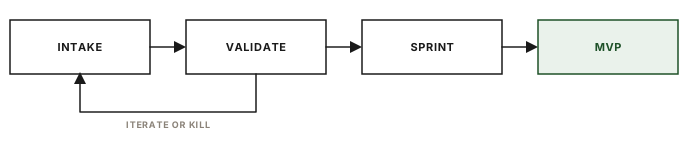
- Defined intake criteria so every idea entered the system on equal terms — evaluated against business outcomes, not internal enthusiasm
- Designed Vellum-powered agent sprints that compressed 9-month discovery cycles into structured 1-hour sessions
- Built the validation loop: a repeatable process for testing prototypes against real user and business criteria before committing engineering resources
- Created the cross-functional workflow — the rituals, roles, and handoff points that let the lab operate without requiring my presence in every conversation
- Established documentation standards so institutional knowledge stayed in the system, not in any individual's head
Strategy that stays in a deck is just a pitch. The job was to build the thing that turns the pitch into a working prototype — and then make sure the next team can do it again without starting from scratch.
The lab became a system, not a person.
The measure I cared most about wasn't the prototype count. It was whether the lab kept producing after I stopped being the one running every sprint.
If you're standing up an AI function — or trying to move one past the pilot stage — the challenge is almost always the same: plenty of ambition, not enough infrastructure. I've built that infrastructure once inside a complex enterprise environment. I know what it takes to earn cross-functional trust, design processes that survive the people who created them, and measure outcomes that leadership actually cares about. That's what I'd bring to your team.