When Skeptical Partners Watched the System Work Live
The plan was four demos at the Annual Partner Meeting. Fifteen happened. Partners who'd doubted the whole concept watched vague SME conversations transform into researched, clickable opportunity decks — in real time.
Innovation discovery was the constraint, not the ideas.
The organization had no shortage of innovation ambition. What it didn't have was a way to explore multiple opportunities simultaneously without it taking months per idea. Every discovery cycle meant weeks of SME interviews, manual framework application, and prototype development — and you could only run one at a time. The process itself was the bottleneck. At that pace, identifying a meaningful opportunity pipeline would take years.
Speed alone wasn't enough. The output had to be credible — rigorous enough that leadership would treat it as strategic intelligence, not AI novelty. Any workflow that sacrificed analytical depth for speed would be dismissed before it could prove its value.
A multi-agent pipeline that preserved rigor while eliminating the wait.
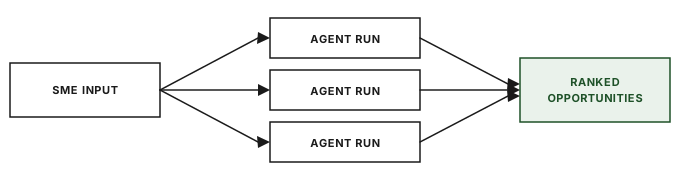
- Designed the agent architecture: structured SME interview format, automated JTBD framework application, ranked opportunity output
- Built the pipeline so it could run multiple opportunities in parallel — what previously required weeks per idea now ran in hours per sprint
- Engineered the output format to produce clickable, presentation-ready opportunity decks directly from each session
- Established the validation gate — human review of scored outputs before anything moved to prototype — so strategic rigor stayed in the process
The plan was to run four structured interviews at the firm's Annual Partner Meeting. Partners would see the workflow in action and assess whether it was worth scaling. Fifteen happened. Partners who'd walked in skeptical — who'd seen plenty of AI demos that impressed in the room and disappeared after — watched a vague conversation with a subject matter expert turn into a researched, structured, clickable opportunity deck before they left the booth. That reaction wasn't planned. It was the system working exactly as designed in front of the people who most needed to see it.
A repeatable asset, not a one-time result.
The first run generated 23 validated innovation opportunities totaling $933M in potential market value. But the more important outcome was structural: run it again, get more opportunities. The workflow became a standing capability — not a project with an end date.
If your innovation function is generating ideas faster than it can evaluate them — or if you're trying to explore multiple strategic directions simultaneously without a six-month research cycle — this is the kind of infrastructure that changes what's possible. I've built it, run it live under pressure, and designed it to compound rather than expire. That's what I'd bring to the next problem.